
Remember that you must die
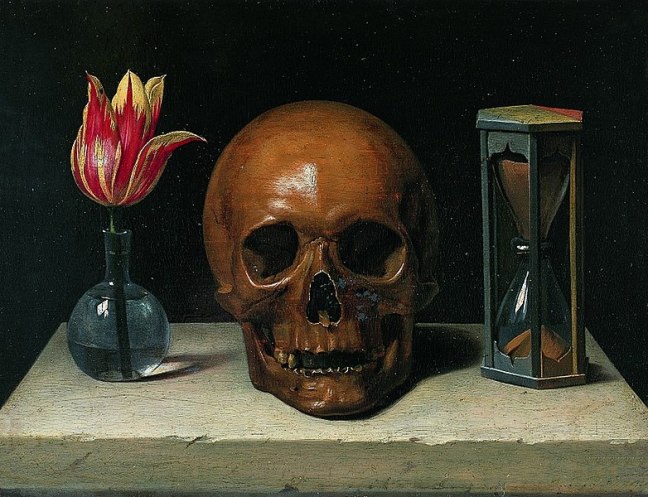
I can’t remember when, but I believe I was reading a book, probably studying Stoicism, when I came across the phrase – MOMENTO MORI.’ Of course, it got the best of me, so I did some research, and in the process, I came across this image. I decided to use it in a blog post. Of course, like most “projects,” this got its start years ago, and now, finally, I am getting around to writing something up on it, and so here we are.
The image used in this blog is from the artist Philippe de Champaigne’s “Vanitas 167,” which speaks to three things: Life, Death, and Time. Each piece in the image represents the shortness of life.
It is easy to get caught up in the imagery of this picture. It is not just a skull alone but a flower, skull, and hourglass, all of which point towards something, all intended to drive home something deep. All are designed to leave a lasting impression on the mind.
The point of the Memento Mori, though, is not to cripple you with thoughts of death; actually, quite the opposite. Its design is to prompt you to reflect on the brevity of life and the vanity that accompanies it, and to ponder and appreciate the life you have NOW! Too many are caught in life’s rat race, and before long, the light of life begins to dim and soon distinguishes, all for what?
Memento Mori is intended to prompt us to reflect on life ITSELF, to live each moment well, and to acknowledge that death awaits us all – TO REMEMBER WE MUST ALL DIE!
As a preacher, sermons, lessons, and general talks about death and life are often brought up, usually in the context of life after death. While the Stoics and Romans adhered to certain views on life and death, the early Church held to Christological views that were validated through the accomplished, all-sufficient atoning work of Christ.
The question today is, how do we live and die? Are we living life through the lenses of scripture? Are we anchored to Christ, our hope in life and death? Do we live in the realm of hope that is inspired by Christ and the apostles, or are you settling on the dreadful, uninspiring philosophy of secular humanism?
As for me, I have found my rest in Christ, and Christ’s redeemed have found in him hope both in life and death.
How can we be certain? Because the tried and true pure word of the living God tells us – That by two immutable things, in which it was impossible for God to lie, we might have a strong consolation, who have fled for refuge to lay hold upon the hope set before us: Which hope we have as an anchor of the soul, both sure and stedfast, and which entereth into that within the veil; – Hebrews 6:18-19
The life of Christ was a testimony of grace, mercy, and love; his death was an open display of and solidification of all things concerning his passion. His bodily resurrection was witnessed by many, including five hundred brethren at once. His resurrection took the sting out of death, triumphing over it and leading the way for all those who would repent and trust in him for forgiveness of sin and eternal life.
Jesus had this to say in John 10:10 “…I am come that they might have life, and that they might have it more abundantly.”
The wording Christ used here is meant to take us above and beyond the “normal” things of life. What he is referring to are those things that lead to a genuinely happy and fulfilled life. We are not meant to live merely for existence, a material or even a moral life, but rather a spiritual life that grows stronger, making you abundantly blessed and happy. This can only happen when our lives are hid with Christ in God.
Romans 6:23 For the wages of sin is death; but the gift of God is eternal life through Jesus Christ our Lord.

